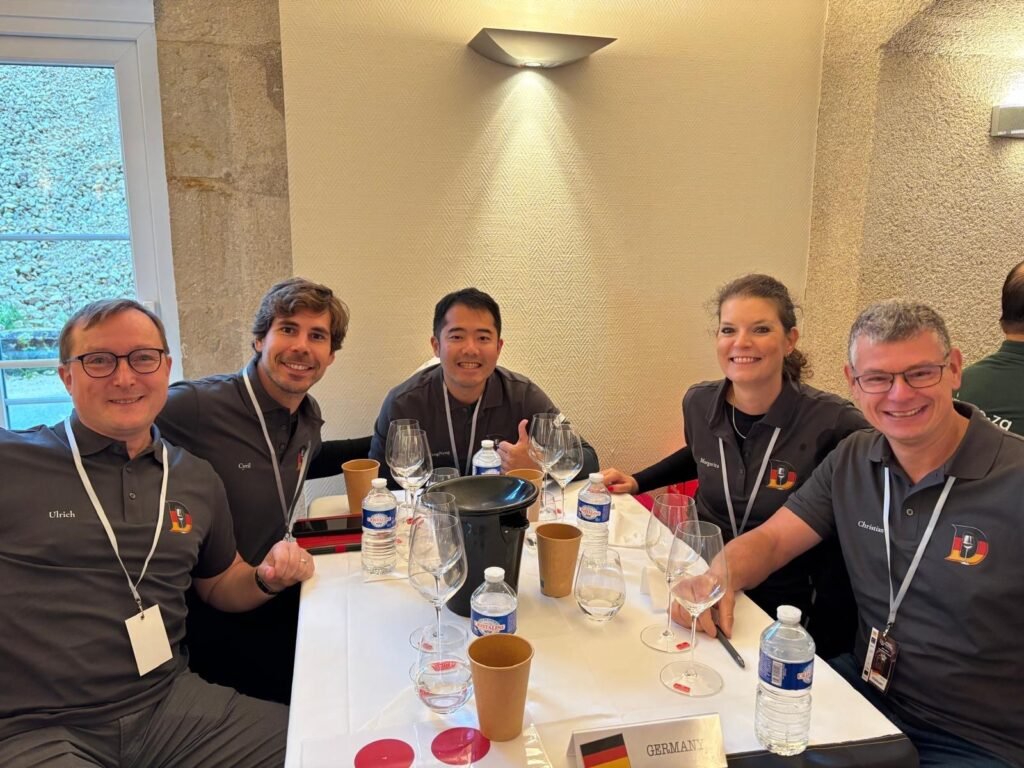
I had the honor of participating once again with the German team in the Global Blind Wine Tasting Championship organized by the renowned French magazine La Revue du vin de France, in the Jura region of Eastern France — region known for its unique wines and cheeses.
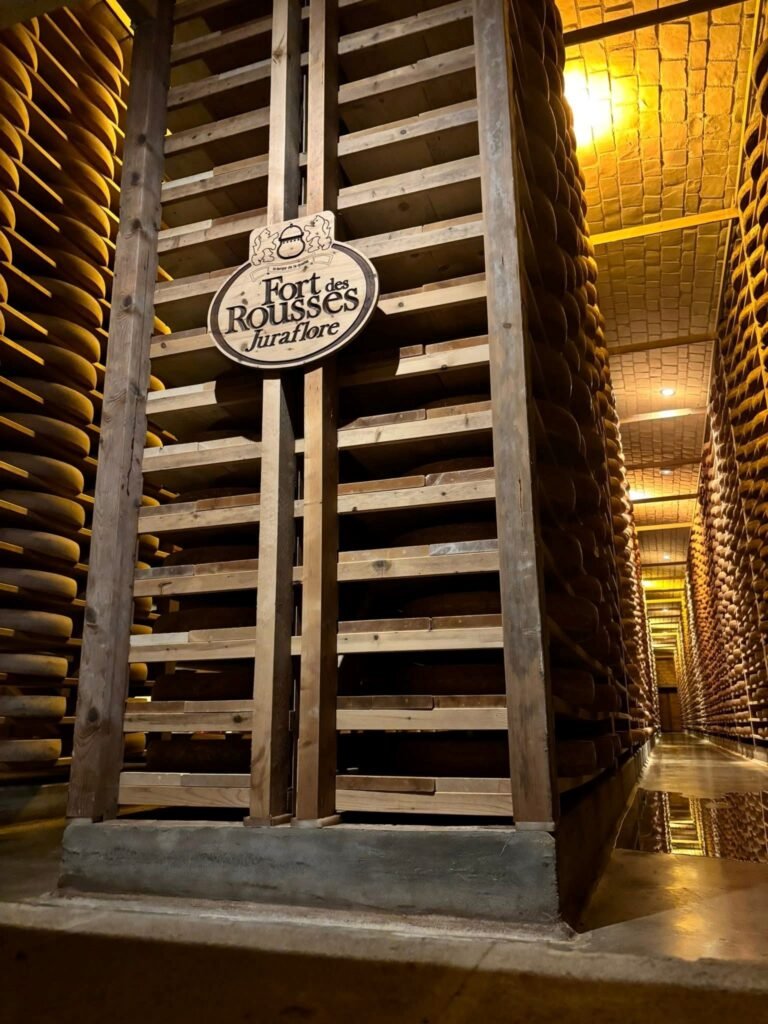
The event took place at Juraflore – Fort des Rousses, a cheese factory famous for its Comté cheese. JuraFlore Comtés are described as having fruity and toasted / roasted notes (“fruité et torréfié”), hints of almonds, butter, maybe spices, citrus depending on age. As the cheese ages longer, these flavors deepen.
Jura is a small but character-rich wine region lying between Burgundy and Switzerland, stretching over 80 kilometer through the Revermont region. Winters are cold, summers warm, and rainfall significant; soils are typically marl, limestone, clay, often at elevations between 250-450 m.
Key grape varieties include Savagnin – the soul of Jura. This ancient white grape, related to the Traminer family, is capable of extraordinary expression. It is most famously used for the production of Vin Jaune, a golden, oxidative wine aged under a natural veil of yeast (voile), reminiscent of Fino sherry but uniquely Jura in character—nutty, spicy, with notes of curry, walnut, and saffron.)
Chardonnay – The world’s most famous white grape finds a very different voice here. Jura Chardonnay can be crafted either ouillé (topped-up, non-oxidative, fresh and mineral) or sous voile (oxidative, deep, and complex
Poulsard – A delicate red variety producing pale, translucent wines with ethereal aromas of wild strawberry, rose petals, and spice. It’s a favorite in Arbois and Pupillin, where it captures the essence of lightness and finesse
Trousseau– slightly darker counterpart to Poulsard, offering structure, ripe red fruits, and earthy tones. Trousseau wines often age gracefully, revealing layers of black cherry, pepper, and subtle game
Pinot Noir– Introduced from Burgundy centuries ago, Pinot Noir finds new expression in Jura’s cooler microclimates, yielding wines of freshness and minerality rather than opulence.
A Spectrum of Styles
Jura’s wines reflect both tradition and experimentation, with styles ranging from crystalline whites to powerful oxidative icons:
Vin Jaune (“Yellow Wine”) – The crown jewel of Jura, aged a minimum of six years and three months under a veil of yeast in oak barrels, never topped up. Bottled in the distinctive 620 ml clavelin, Vin Jaune is a wine of meditation—dry, profound, and endlessly layered.
Vin de Paille – Made from grapes dried on mats or hung in a well-ventilated room for around 3 months to concentrate sugars, producing luscious, amber-colored dessert wines with aromas of dried fruits, honey, and spices.
Crémant du Jura – Elegant sparkling wines made in the traditional method, offering fine bubbles, citrus zest, and a mineral edge. These wines showcase the region’s precision and growing sophistication.
Macvin du Jura – A fortified wine (white, red or rose) made by blending grape must with aged Marc du Jura (brandy), then matured in oak. Rich yet balanced, it’s both a local curiosity and a cultural emblem.
Oillé whites and reds – More contemporary styles, topped-up during aging to prevent oxidation, revealing freshness and fruit purity, showing that Jura can be both ancient and modern.
The region’s flagship appellations—Arbois, Côtes du Jura, Château-Chalon, L’Étoile, and ”product” AOCs Macvin du Jura, Crémant de Jura and Marc du Jura —each carry distinctive identities. Arbois, the beating heart of Jura, is home to pioneers such as Louis Pasteur, who once studied fermentation in these very vineyards.
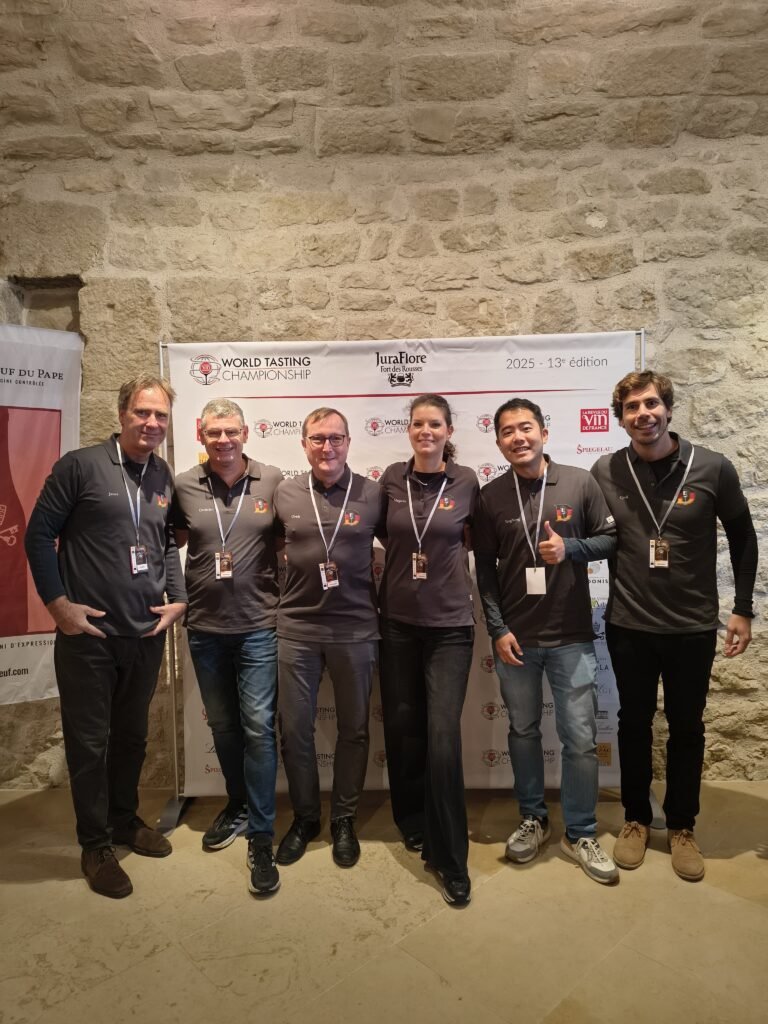
At this year’s competition, the German team got off to a very strong start. Through the early rounds, the discussions and analytical work were excellent and even moments where two answers were on the table — at least one of them correct; But as the competition progressed, particularly toward the final rounds, the team found itself struggling. Despite the insight and debates, some answers that seemed well supported turned out to be wrong, and the team slipped in the rankings. But this is precisely where learning happens. That discrepancy between “one of our plausible answers was correct” and “we didn’t land it” is valuable data: it shows that the level is high, that with a few tweaks in strategy or mental preparation, the team can close the gap.
We are proud of what we accomplished and with reflection, practice, and confidence, the next competition may see us maintain that early strength all the way through.
Team Germany:
Coach: TengNeng Huang, DipWSET, Wine Journalist
Christian Weisenstein, DipWSET Certified Educator, Port Educator, Sherry Educator
Ulrich Hagenmeyer, Sommelier (IHK), DipWSET
Cyril Meidinger, DipWSET, Wine Importer
Margarita Martini, DipWSET, Wine Journalist
Team support and backup:
Tobi Schüle, WSET Level 3, DipWSET student
Janez Zdesar, DipWSET
The wines:
- Chardonnay 80 %, Pinot noir 20% , France , Champagne, Ayala Perle, 2012
- Verdejo, Spain, Rueda (Castilla y Leon), Bodega Gil Shaya Habis, 2022
- Chardonnay, Australia, Margaret River (Western Australia), Moss Wood, 2022
- Riesling, Slovakia, Muzla (Région Nitra), Château Bélà Egon Muller, 2020
- Pinotage, South Africa, Stellenbosh, L’Avenir, 2021
- Pinot Noir, USA, Santa Ynez Valley (Santa Barbara), Au Bon climat Sanford and Benedict 2020
- Tempranillo, Spain, Rioja, Artadi, 2022
- Touriga Nacional, Portugal, Douro, Quinta do Crasto, 2019
- Grenache 30%, Syrah 30%, Mourvèdre 30%, France, Châteauneuf-du-Pape, Les Fines Roches, 2017
- Corvina 35%, Corvinone 30%, Rondinella 20%, Italy, Amarone della Valpocicella (Vénétie) Tedeschi Marne, 2020
- Riesling, Germany, Rheingau, Schloss Johannisberg, 2021
- Furmint 70%, Harslevelu 30%, Hungaria, Tokaj Szamorodni, Zoltan Demeter, 2021